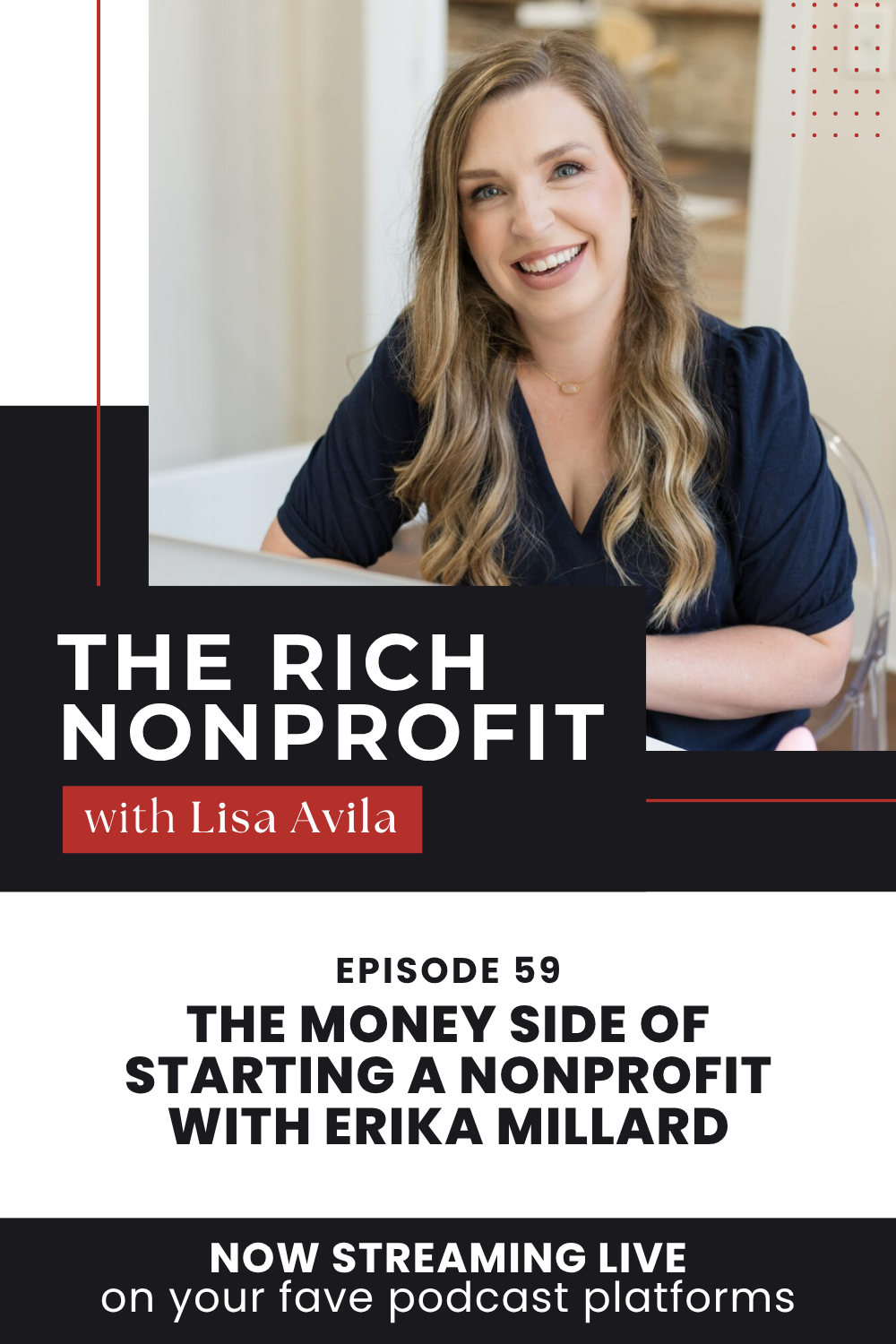
Episode Shownotes:
You’ve got the mission on your heart and the drive to match. But should it be a nonprofit, or should you keep running a mission-driven business? And once you decide, what does the money side of this look like when nobody’s handing you a manual?
This week on The Rich Nonprofit, Lisa sits down with bookkeeping and QuickBooks expert Erika Millard for an honest, back-and-forth conversation about what it takes to start and scale a nonprofit, from both the strategic and financial sides. They cover when a nonprofit makes more sense than a business, the systems you need before you think you need them, how to stop avoiding your numbers, and why paying yourself as a founder is not optional.
If you’ve been sitting on a nonprofit idea or you’re early in the build and feeling overwhelmed by the financial piece, this episode gives you the clarity and the structure to move forward.
Main Topics Discussed:
- How to know if your idea should be a nonprofit or stay a mission-driven business
- Why Lisa recommends starting with impact in your brand before going full nonprofit
- The first systems every nonprofit founder needs (donor management + bookkeeping software)
- TechSoup: the money-saving hack most founders find out about too late
- Finance Friday and other ways to make bookkeeping a habit you keep
- Why keeping personal and nonprofit finances separated matters from day one
- How networking fuels nonprofit funding (and it’s simpler than you think)
- Board relations, grant applications, and why your numbers need to be dialed in
- When and why nonprofit founders should start paying themselves
Resources Mentioned in Today’s Episode:
- Brand Impact Strategy: 90-minute intensive to map impact into your brand
- TechSoup: discounted software for nonprofits (techsoup.org)
Connect with Erika Millard:
- Website: https://erikamillard.com/
Ways to Keep Working with Lisa:
- JOIN MY FREE TELEGRAM COMMUNITY · Where I drop resources, answer questions, and connect with women building impact into their brands and nonprofits.
- BUSINESS IMPACT STRATEGY · 90 minutes, one-on-one. We map your next moves and how to incorporate impact into what you’re already building. You walk away with a plan you can start right away.
- MOMENTUM · Two days one-on-one with me in California wine country. We build your six month strategic roadmap for the brand or nonprofit.
Connect with Lisa:
- Instagram: @lisathestrategist
- LinkedIn: Lisa M. Avila
- TikTok
- YouTube
- Email: hello@poppygrovellc.com
- Website: www.poppygrovellc.com
Episode Transcript:
Erika Millard (00:07)
Well, hey friends, it’s Erica and Lisa here, and we’re really excited because today we are kind of testing out having one conversation that’s going to serve both of our audiences. And so this conversation will be airing on both of our podcasts, which is really fun. So let’s get into it. So first for anyone who doesn’t know you, Lisa, can you tell us a little bit about what you do and who you help?
Lisa Avila (00:35)
Yes, of course. Hello, everyone. I’m Lisa Avila and I’m a nonprofit strategist. So I help women start and scale their nonprofits. And I’m also helping women entrepreneurs as they move impact into their businesses. So those who aren’t necessarily ready for a nonprofit, because that’s kind of what we’re finding. That’s like, let’s bring some impact in. That’s your first move. And then we’re going to.
Get that nonprofit going because we all want to change lives and help our communities.
Erika Millard (01:07)
Yeah, I feel like we’re going to talk about that and the difference a little bit more in this conversation because I’m excited to hear more about that. So what first drew you to working in the nonprofit world?
Lisa Avila (01:20)
I was in the wine industry for quite a while and I saw a lot of disparities, a lot of people who needed help and I just felt like, you know, I could be doing more to help people. And that’s how I went back, got my master’s in education and took that and moved into the nonprofit world. And I just love, I just love helping people. I’ve always had a heart on my sleeve and it’s a lot of fun for me.
Erika Millard (01:47)
That’s so cool. What made you passionate about helping women specifically start nonprofits?
Lisa Avila (01:57)
I love working with women. just, especially, moms are drawn to me because I’m a mom of three. I know you’re a mom. And it’s, we have so much compassion and we want to help people. And what better way to do that than to start a nonprofit with something that you care about so deeply. Cause you can make such a big impact when you have a nonprofit or a foundation.
Erika Millard (02:24)
Yeah, I feel like I see this with the clients that I work with that are nonprofits starting out because they didn’t really intend to start a nonprofit necessarily. They just had some kind of passion or burden for a specific situation or people group. And then it kind of morphed into, this got bigger than I thought and maybe it’s time to make it legit. So I’m excited to be talking more about that on this episode.
Lisa Avila (02:52)
Yes, yes, it’s so true. And so for my listeners, Erica, who are meeting you for the first time, I’d love to know about your work and how you are helping business owners.
Erika Millard (03:03)
Yeah, so I am Erica Millard. I’m a bookkeeping and QuickBooks expert and I help service-based small businesses as well as nonprofits either set up, clean up, or hand off their bookkeeping. So no matter what part of the journey that you’re on, if you’re just starting out, all the way to being ready to fully outsource it, we have options available and really just love supporting female business owners, nonprofit runners.
founders who need help understanding their numbers because I really want to help you take you from just compliance to actually understanding what the numbers mean so that you can make better empowered decisions.
Lisa Avila (03:51)
Thank you for doing that because that is not for me as a business owner, it can be so overwhelming to look at my numbers that sometimes I just kind of push it to the side. But when you are empowered with your budget and knowing it’s so much better, like it takes so much out of your brain. So that’s so nice.
Erika Millard (04:13)
Yeah, totally. And what I saw over and over was just like you said, it’s very common that people stick their heads in the sand because they’re kind of worried about what they’re going to see. And so they’d rather just avoid it than actually face what the numbers are going to tell them. But more often than not, I saw people doing better than they thought they were. And so that’s actually an encouragement for those listening of often you’re doing better than you think. And having that
head in the sand actually just like drags out and magnifies the fear and the anxiety instead of actually knowing what’s going on and then being able to make a decision about it. So that’s why I’m just so passionate about helping women specifically because we can easily feel intimidated by all the terminology.
And I’ve had a lot of clients with just bad experiences with bankers or CPAs or like lots of tears, lots of feeling dumb. And so I’m really, I really want to make it judgment free. No shame, just like we’re chatting over coffee about it.
Lisa Avila (05:21)
Yes. ⁓ I love this. And what led you into bookkeeping and the financial education piece of it?
Erika Millard (05:29)
Yeah, so I actually have an accounting degree and funny story, I went into accounting because I wanted to be in the FBI and they were really heavily recruiting for financial and like white collar crime at the time. So that was my initial goal. I would always go around in college telling people I’m an accounting major, but for a cool reason. um, and that dream just never really was fulfilled.
But I worked in corporate accounting for several years and then when my oldest was born, I knew I didn’t want to work 60, 70, 80 hours a week, but I also got bored very easily with just one baby at home. And so I had thought about starting my own business and kind of through some crazy circumstances got a handful of clients. But after a while, I was just doing full service bookkeeping and feeling like, man, I have some
like coaching type of tendencies, but I don’t know how this fits with bookkeeping. And when I started marketing my services, I had several women over like the span of six weeks say, well, I can’t afford a full service bookkeeper, but could you just teach me how to use QuickBooks or could you just review my reports so that I can understand what this means or could you just help me not cry in front of my CPA? Literally someone said that.
And so I was like, okay, well maybe there’s something here. And I went and did a little market research and couldn’t really find that many people helping those people who are starting out or were pretty good about actually being disciplined to do their bookkeeping. They just needed help with like some troubleshooting or really understanding. And so that’s kind of how this morphed into more than I really ever expected.
I think not many accountants can teach and so I just feel like I was gifted to be able to help people in this way of just being able to break it down, making it simple and easy and practical and doable because I feel like so much of what we see online is like, we’ll just leave that to the experts. And there’s a time and a place for that, but I also think this can be really simple and like the everyday person can understand it if you actually know what you’re looking for.
So that’s kind of how it all morphed together into having the whole journey of support available because not a lot of people were helping those. And so that’s what I really, it came from people asking me for that kind of help.
Lisa Avila (08:05)
It is such a great idea because you are such an approachable person. And I have found with accountants and CPAs that, you know, not all of them for sure, but usually male dominated and intimidating. And so when I met you, I was like, oh, that you are a breath of fresh air. And yes, I don’t I feel like I could ask you a question and not feel dumb.
Erika Millard (08:25)
Thank you.
Yeah, and that’s why it’s funny because I have like this pink branding and like just very different than people have said like, I never associate this with accounting. And I’m like, yes, that’s the goal.
Lisa Avila (08:42)
Yeah, you can bring some fun and some ease into it. It doesn’t have to be just spreadsheet.
Erika Millard (08:50)
Yeah, and I think, you know, that’s part of my mission too is just this can be way more cozy and casual than what it’s become, I think, in the online space. But I also want people to feel like, ⁓ I can actually, I have a seat at the table too. Like it’s not just for the stuffy professionals. So thank you for saying that.
Lisa Avila (09:13)
Yeah, it’s true. All right, go ahead, sorry.
Erika Millard (09:18)
No, okay, so when someone has a big idea for helping people, Lisa, how do they know if it should actually become a nonprofit? I feel like this is a tricky question of should I formalize it or is it just like the mission? So how do they know the difference?
Lisa Avila (09:39)
It’s interesting because as I said before, women, care so deeply and a lot of us get to the point where we want to do more. And so what does that look like? Especially when you have more time, more bandwidth, my kids are getting older. And so I’ve gone through this with women as they’re like, ⁓ I have more time and I want to create more impact. And so I sit down with them and we talk about it. Like, what is your capacity? What is true for you? What keeps you up at night?
And I have a framework that I take them through. I call it the four P’s. And so it’s people, purpose, promise, and platform. And we don’t have to get all into it. But I’m very strategic when I help these women make that decision because it’s a big decision to start a nonprofit. You’re going to be very busy. You’re eventually going to want to hire a team. And you have funders that you have to give numbers to and explain things to.
So it’s a lot, but it also can be very rewarding. And so I like to, if they are business owners already, I encourage them to start with a little bit of impact in their brand. But let’s bring that in right now and see, you don’t have to go full bore nonprofit. Although I know that you’re going to probably end up there, but you know, well, it’s just like baby steps. And so that’s what we do.
Start with the impact that could be a scholarship, that could just be working with another nonprofit. See if you like it. And usually it’s, my gosh, I want more of this because you see the impact that you’re having. You see the communities, the people, the lives that you’re changing. And so then it’s time to, you know, take it bigger and decide I’m going to start that nonprofit because I want to have my own programs. I want to have my own events and fundraise and help more people.
Erika Millard (11:31)
That’s really cool. I love that you encourage some baby steps because I think so many of the women that I work with have that kind of value where they want to give back or they want to be able to fund different things that are important to them. But I think sometimes that can feel so giant. Like I have to start this whole other thing. ⁓ And how am going to do that when I have this other business or this other thing that I already do?
I love that recommendation of just, we’ll just start somewhere and then kind of let that almost lead, ⁓ do I want to do my own events? Do I want to do my own? And so that being kind of a determining factor.
Lisa Avila (12:14)
Yeah, and just to see how it works for you and for your life because the reality is we are so busy as women. We have so much going on. A lot of us are taking care of children and our parents. And so you’re in this like, woo, how am I going to add one more thing to my plate? But we do also have those core values and want to give back and we want to help. And especially right now with, you know, the world is a little bit wild and
It’s a great way to start. It’s just what can I do right now to create that impact?
Erika Millard (12:49)
So what would you say are some common misconceptions people have about starting a nonprofit?
Lisa Avila (12:56)
Well, I think they believe it’s gonna be easier than it is because you do have your heart on your sleeve and you just want to go help people. so you don’t, not you general, they don’t think about the strategy behind it because a nonprofit is a business, right? It is not for profit. You’re putting the funds back in to impact more people, but it’s still a business. You still need to think about finances, staffing.
⁓ HR, all the things as your nonprofit grows. And so it’s great that you want to help people, but setting up systems and strategy at the beginning is a very smart move.
Erika Millard (13:37)
Yeah, and so kind of with that, what are some first steps someone could take if they are feeling that nudge to start a nonprofit? We talked about making a scholarship or things like that, but what’s next right after that?
Lisa Avila (13:52)
Yeah, what’s next is if, well, you’ve got to get some money. And so I think it is networking. I am always encouraging nonprofit owners, founders, go out there and get visible. Start talking to your community and what they need. Start talking to people who care about the cause so that they can help you with donations and funding because you’re always going to wear a thousand hats as a nonprofit founder.
Which is fun, I love wearing a thousand hats as an entrepreneur, right? You’d never get bored. But it can get overwhelming, especially if you don’t have that money. And so I would say strategy and money as you are starting your nonprofit is going to just ease a lot of that chaos.
Erika Millard (14:37)
Do you have tips for where to start networking? Because I would imagine you might not feel completely welcome in like a small business setting per se. are there certain places that are better? Do you find other people with the same interests of cause? where do you look to network?
Lisa Avila (15:00)
Yeah, that’s a really great question. It depends on who you want to serve. So for instance, I have a client that works with people who have the same skin condition as she does. And so she’s on, when she first started, she had a full-time job, she started her nonprofit and she was on Facebook pages and in groups and just talking with other people who have the skin condition. And then they know somebody who is in corporate or they know somebody who’s in pharma. so it’s just,
making those connections with people who have the same, it could be like the same skin condition or the same desire to help, let’s say you want to help education, right? You want to help kids. That’s what I do. I do school board advocacy. So when I’m networking, I’m talking to other parents in my local community and then they know somebody who knows somebody who wants to donate. And so it really, does have that ripple effect, but that’s how it starts of finding who has the same kind of core beliefs.
and causes that they want to be behind and just start talking. Just have the conversations. It doesn’t have to be a whole slide deck. It doesn’t have to be anything formal. You can show up to a sporting event or, you know, wine with some ladies and just start talking. And you never know who you’re going to meet that says, my gosh, I want to help you with that.
Erika Millard (16:19)
That’s awesome and makes it feel simple and doable. So thank you for sharing those tips.
Lisa Avila (16:27)
Yeah, it doesn’t have to be as hard as we want to. I love to overthink things, but it really is just starting the conversations and then seeing where they go. Yeah. But I want to ask you from the financial side, though, what are some things that people should think about when they are starting a nonprofit?
Erika Millard (16:47)
Yeah, I think the first couple things are number one, you really need a system. So you need some kind of method to track your donations and also to track it by the specific donors. So really early on, I think a donor management system is helpful because it will help you keep track of those ⁓ people who are donating and then usually helps you prepare like
statements for tax purposes for them as well. And then you need some kind of bookkeeping software. I mean, a spreadsheet is okay for a season in the early beginning, but when you start to get to the point where you’re manually entering a lot of things, or if you’re really not a spreadsheet person, or if you start to find a lot of duplicates, or if you type numbers wrong in your spreadsheet, there’s a lot of room for manual error. So we don’t really like to have that.
to leave a spreadsheet for too long. And a software will really help automate some of those things for you and help you make it a little bit more legit. So if you’re reporting to a board or if any of your donors really request, hey, can I see your financials before I donate? A software will help you make it look more professional than just an average spreadsheet. So those are some things to think about.
One, I don’t know if you talk about this, but Lisa, but one money saving hack is to get a membership with TechSoup because they will give you a very discounted version of QuickBooks as well as all kinds of other softwares and tech stuff. And so a lot of people, well, actually a lot of my nonprofit clients find out about that after they’ve already signed up for QuickBooks and then…
it’s really a pain to switch it over. So if you’re going to do it, I recommend starting from the very beginning and get your subscription from there. But those are the first couple of things, just how you’re to track the donations that you’ve gotten from people and then all of the other bookkeeping. Usually it’s both of those systems working together, a donor management system and something like a QuickBooks that works together so that you have, you cover all of the donation and then expense side of things. So
Then you want to think about, what’s my routine with my bookkeeping going to be? Am I going to do this every single day, which is not necessary? Are you going to do it, look at it once a week, once a month? I recommend monthly unless you have some other reason to be, like if you have a big decision coming up, you may want to look at things more closely, but minimally monthly, keeping up with your bookkeeping because it’s fresh on your mind.
You’ll remember what your expenses are for, you’ll remember more of those types of things where if you wait until the end of the year, you’re not gonna remember why you bought that Amazon purchase or whatever it was. And then it can just get really overwhelming. So if you keep up with your bookkeeping, it can really become simple and easy. ⁓ often clients will put just a recurring date on their calendar so that they’re like, okay, it’s Finance Friday, I’m gonna look at it.
So you need some kind of system and then a routine for actually keeping up with it unless you’re ready to just outsource that to a bookkeeper right away. often I find nonprofits can’t afford that right away. So they need just some support either setting it up and then maintaining it themselves until they’re kind of at that place that they’re ready to outsource.
Lisa Avila (20:26)
Yeah, that is so smart to set it up recurring. So I like that. What did you say? Finance Friday?
Erika Millard (20:32)
Yes, a lot of people do Finance Fridays. And then I have another podcast episode on this, but sometimes you’re going to have to use a hack to force yourself to make it fun. So sometimes people will go to a coffee shop and get their special coffee and that’s their treat to actually do their bookkeeping. Sometimes people will light a certain candle and kind of like make a ritual with it and just kind of get yourself motivated to do it.
Some of my clients are more and more motivated by pain than fun, and so they won’t pay themselves until they’ve done their bookkeeping. And so that’s kind of another hack. Like if you want to pay yourself, then they’ll just force themselves to do their bookkeeping first. So whatever it takes to actually do it, you know, sometimes we just have to make a new habit if we’re not used to doing these kinds of things. And it can be really intimidating in the beginning if you feel like, I don’t know what I’m doing.
and then you’re just gonna put that off til later. So sometimes you need something fun or motivating to get you there.
Lisa Avila (21:36)
This is such a great hack for any business owner, right? Any female entrepreneur made me think of like, yeah, when I didn’t want to go to Pilates for the first time, because I was so intimidated. But then once you go and you start to see the change and you feel good, it’s like, ⁓ I can do that.
Erika Millard (21:53)
Yeah, and really it usually only takes clients a couple times before they’re like, I made this this huge mountain and this really isn’t that hard. And so that’s my goal for every business owner or founder is to get you to the point where it feels like this really isn’t that hard. Like I am capable and I can do this.
Lisa Avila (22:13)
Yeah, oh, that feels, I like that. That’s very nice. Are there any other money systems that founders should think about when they’re setting up early?
Erika Millard (22:24)
Yeah, I think the main thing is keep your personal and your organization or business expenses separated. That’s going to be a big deal for the nonprofit status. So you want to make sure that that’s separated. So go ahead and open up. I think you might need the 501c3 paperwork, but ask different banks to verify. But get a separate bank account so that you can easily keep things separated.
And then another thing people forget about is have some kind of system for keeping up with your receipts. Often people think that, ⁓ I have my bank statement and that is not good enough for the IRS. So you really want to have some receipts so that like in the example of Amazon, well, how do we know that wasn’t for pajamas versus office supplies? Like we don’t know unless you have a receipt. So really focus on the things that are a little more in that gray area. ⁓
Sometimes subscriptions, those are pretty easy to go to that expense website and look up their pricing and be able to verify that. But it’s more these things that are a little more gray or more difficult that an auditor might look at and say, well, how do I know that wasn’t something personal? So those are a couple more systems to get set up so that you have a good structure for how you’re going to verify the things that you’re purchasing.
Lisa Avila (23:50)
Yeah, and it’s another good habit to start early with because then it just, then you think about it and do it instead of just, ⁓ deal with that later.
Erika Millard (23:59)
Yeah, and again, it’s like, well, how are you going to remember that receipt from last January? Like, so that’s another reason to try to keep up with it monthly or quarterly if you really can’t get to monthly. But just don’t let it linger for a whole year because that’s when it can get super overwhelming. And if you’re in that place listening to this where you have let it linger, like no shame, we can get you caught up and cleaned up and then make a step from there.
but it’s much easier to do it right from the beginning than be in a mess later.
Lisa Avila (24:32)
I appreciate that you brought that up. I have had clients where they did push it off just because they were so busy, right? That was just got pushed down the list. But then at the end of the year, it was pretty scary of how am I going to figure this all out? And that’s where you come in because you can help them figure it out and then get them set up. I’m assuming where moving forward, it doesn’t have to be like that.
Erika Millard (24:55)
Yeah, exactly. Yeah. We talked about this a little bit, Lisa, but let’s talk a little bit more about nonprofit versus business. So is there a little bit more of a difference that you can talk to us about ⁓ starting a nonprofit versus when do you just keep a mission driven business and keep that piece running?
Lisa Avila (25:20)
Yeah, sure. I’ll go back to an example from my client. So she wanted to run programs. She wanted to help people with her condition and she wanted to help them directly, which you can with a business, but with the nonprofit, you can get the funding, right? So that you can start these programs right away. So instead of.
going out there and trying to get sales from the people you want to help, right? As a coach or a mentor would, you are getting money from funders and then you can serve these people through programs. And that way, if the communities say don’t have the means, then you can serve them and they can do it, let’s say for free or low cost. You can put on events and everybody can come as opposed to only the people who can afford it.
And that’s what you find in a lot of nonprofits. You’re serving kind of lower end income, marginalized people, and so they don’t have the means. And when you are so mission driven, you want to help everyone, not just the people up here. And so that’s how I see the difference with a nonprofit. You can serve more people who need the help by going and getting that funding as opposed to charging them directly.
Erika Millard (26:39)
Yeah, I love that because it can feel difficult to figure out which path to go. So I think that’s another just helpful, almost like checklist of do I meet these criteria or not in order to know which way to go.
Lisa Avila (26:56)
Yes. Yeah. And at the end, you know, like I said before, if you do have a business, just helping wherever you can in the beginning is a great way to see if you want to take it further or not. And that’s okay. You’re still helping people. You’re still creating impact. It’s just which avenue do you want to go to create that legacy down the road?
Erika Millard (27:17)
Yeah, so what are some pros and then maybe some challenges that people may not realize about going that nonprofit route?
Lisa Avila (27:25)
Yeah, the pros to me are that you can impact more people. And I have a client who is currently going global because she is able to get the funding and people want to support corporations, want to support her. So she is going to help millions of people. Whereas if she had just stayed a business, she’s helping her local community and she’s helping people here and there. But global impact, I mean, that’s
Right, that’s amazing. Amazing. And the legacy that she’s creating for her children, which I feel I’m creating legacy for my children as an entrepreneur, but on the global scale of, you know, moving, if her children want to move into the nonprofit and help as well, then that’s a really cool legacy. Yeah. So those are pros that I see. Yeah. The cons, it’s a lot of work.
Erika Millard (27:55)
Yeah.
Lisa Avila (28:22)
And especially when you’re starting up and you’re trying to get that funding, then you’re going to be doing a lot of different things. And that can be challenging if the founder maybe hasn’t done much marketing or sales. That visibility piece for founder is a big deal because as we talked about before, the networking, you have to put yourself out there. And if you are really shy and you just want to kind of help people in the background, it’s going to be tough. But.
I feel the more that you put yourself out there and you start helping people and you see that working, then it gets, the confidence grows and it gets a little bit easier.
Erika Millard (29:02)
Yeah, that’s so cool. And I love that, you know, sometimes we just have to push past our comfort zone, no matter which route we choose. And it’s like, we’re going to be busy, I mean, no matter what. And so I like how you even shared that there’s some global impact. like the thing, if you don’t go that way and you could have you’re missing out on
potentially the impact and influence that you could have on people you don’t even know about yet.
Lisa Avila (29:35)
Right, right, and it’s not for everyone. There is nothing wrong with people who are creating impact in their local communities. We need that. We surely need that in America right now. But there are some who are called to a higher purpose. I would say purpose. And so for them, I feel the nonprofit route is a great way to go.
And so I’m wondering when, if someone does decide to start the nonprofit, like what responsibilities have you seen that kind of overwhelmed them or surprised them?
Erika Millard (30:09)
Yeah, that, especially with the financial world, I feel like that also surprises people just how much it can become over time of tracking and receipts and even just processes and procedures to put in place. So one of my clients, for example, they came to me very early on, so we set them up and
QuickBooks and their donor management system and they’ve been doing it themselves for several years and doing a great job because I’ve seen their numbers now. ⁓ But they just recently circled back and said, hey, we’ve grown so much that we really can’t do this ourselves anymore. And we’ve grown so much that we may actually need a third party audit eventually. And so can you just help us make sure all of our processes are in place so that
we would pass and get a gold star on our audit. And so I think it’s, you might think it’s silly in the beginning, but the more of this stuff that you can do in hopes, or just that you have set up early on so that you don’t have to stress when you do grow and you do expand is helpful. So having those procedures in place of just.
Who’s gonna approve certain things? Who’s gonna, are you gonna be on payroll? Are you not? So some of those decisions to make, even though it might seem silly early on, it’s actually really helpful to have as soon as you can.
Lisa Avila (31:39)
I agree with that. I’m constantly talking to clients about your SOPs, right? Your standard operating procedures, because I want to know how things are going to flow and how things are going to move. So that’s a great point for finances as well.
Erika Millard (31:51)
Yeah. Yeah. So are there some other systems or structures that you see that help them grow in a healthy way?
Lisa Avila (32:02)
And now I’m bringing it back to you. But once they are larger and they’ve been moving through this for a few years and then it’s, ⁓ let’s look at our budgets, which I’m not a numbers person. So I’m always like, whoop, let’s outsource that. But then they come back and they know like how much can I afford for staffing? How much travel?
And so then they can plan out their year strategically, right? Come back to me and we’re going to look at everything you want to do. We’re going to look at the numbers and then we figure out how they can grow. And so that’s been a lot of fun for me. When somebody else does the budget, that’s not, no thanks.
Erika Millard (32:45)
Yeah, I think I often see nonprofits not even think about creating a budget. It’s just like well we’ll just work with what the cash that we do have or the potential donors that we think is gonna come but we don’t even know what we think is gonna come in and ⁓ so I think actually writing it out can be really helpful because I think one of the differences between a nonprofit and a business financial terms is just
who you’re even reporting for. So in a business, you’re reporting for the IRS and then to make management decisions for tax purposes and then decision making purposes. But in a nonprofit, you have a board that you’re responsible to report to as well as all of the donors. And so it’s slightly different, but it does make a difference because there’s not as much accountability, I would say.
for a business as there is for a nonprofit. And so I think that can also though make it intimidating for people because it’s like, I gotta get every single thing like just right because it’s a nonprofit and I’m reporting to all of these people. But you do have a little bit greater of a responsibility to cross all the T’s and dot all the I’s and make things correct because you do have others relying on it.
Lisa Avila (34:10)
Yeah, great point. And when you do go to your board and you have all of that set, they are going to be so happy and they are going to say yes more because they know they can trust you to make those big decisions and have the nonprofit run smoothly. And that board relations can be pretty tricky in a nonprofit. And so you want your board members to trust you, understand you, understand your vision and say yes.
Erika Millard (34:38)
Yeah, that’s a great point. And also this client that I had just mentioned that’s growing, he was saying that some now larger corporate donors are interested in donating, but he’s like, they care a lot more about the math than they do the mission. And so having all of this information so that you can easily articulate, yeah, we can answer your math questions and they can feel good about where their money is going.
That can be really helpful for your donors as well.
Lisa Avila (35:10)
Yep. And when you’re a help client with a really big grant and when you’re filling out all of that paperwork for the application, they want the numbers. They want to see where you have been and where you want to go. And so if you have that all dialed in, that’s really going to help you move ahead in the grant process when so many nonprofits are applying to grants.
Erika Millard (35:33)
Yeah, and you know, that’s where I’ve also heard that networking can really come in is that sometimes even with grants, it can almost be like who you know that can help you push along that process. So I love that it’s all coming back to some of those relationships as well.
Lisa Avila (35:51)
Yep, very important. You’re right, because if you talk to somebody and they are working for that company and they like what you’re doing, then yes, you may have an in and not in kind of a sleazy way, but just of helping it along and getting through when you’re randomly emailing someone, you know, trying to get information. So that is helpful. That networking is very helpful.
Erika Millard (36:13)
Yeah, well, like you said, think even as an individual, I’m way more likely to donate to something that I know someone or I relate to that cause. And so I think that’s just a natural thing is that it’s natural to give to people that you already know. It’s more natural to work with them or give to them. So, OK, we’re talking about giving and some of the money.
How can founders think about paying themselves? Because I know that this can be a challenge when it’s not really a business. And so I’ve seen some founders struggle to actually pay themselves for the work that they’re doing. So what is your kind of philosophy or coaching around that?
Lisa Avila (36:57)
Well, if you do already have a business or you have a full-time job and you start this nonprofit, I would say for any business owner, really, it is helpful to already have a paycheck or to have some money in savings because you aren’t going to pay yourself right away as a founder of a nonprofit because you want to create that impact, which means you want to start those programs and that takes money until you have the funding coming in. But as soon as the funding does come in,
I think it is important to be compensated for your work. A lot of nonprofits, they don’t pay their employees well. When I worked at one, was not, I loved my work, but I had three kids to feed. And so I would love to change the narrative. And I think I am helping do that of you can be paid well and change lives. And so I encourage founders as soon as they can to start taking a paycheck from the nonprofit.
even if it’s little because it also gives you the boost of, okay, this is working. I’m paying myself for my time and my energy. I am valued as the founder and my team is valued.
Erika Millard (38:07)
Yeah, I actually agree with that because I think if you don’t, then you are susceptible to burnout faster because it’s just you’re giving, giving, giving and not seeing any of the reward. so I think most of the people that you and I work with, like we know you’re not going to be egregious of what that amount of pay is going to be. So even a small about amount is.
above average. Like it is well deserved as the founder of the organization.
Lisa Avila (38:42)
Yes, agreed. All right, Erica, as we wrap this up, it’s been so much fun, but I am curious to know one step someone listening could take this week if they do feel called to start or scale their nonprofit.
Erika Millard (40:05)
Yeah, well, I think it comes back to on the financial side of just starting to research. If you’re in that beginning stage, I would definitely get a TechSoup membership and then I would just start to research what systems would be right for you because that’s really going to guide a lot of your setup and starting. And then even go ahead even now and put a Finance Friday or put some kind of
money date with yourself on your calendar and even if all you do is look into is quick books right for me or is I’m going to start a very simple spreadsheet of all the few the handful of things that I’ve spent money on to even research of nonprofit is right for me just those types of things just get yourself started in the habits that are going to continue on with you as you grow the thing.
And then if you are someone who has started and you’re finding you’re in a little bit of a mess, then figure out what your next step is. So is it that you need understanding around your reports? Is it that you may need some education around the softwares or systems that you’re working with? Is it you might need to bring in someone to help you clean it out or straighten it up? Are one of those steps applicable to you, but just don’t stay in the shame and fear?
get some help because that will help you move faster and grow faster going forward. So Lisa, what about for you? What is one step someone could take if they are feeling called to a non-profit?
Lisa Avila (41:41)
that you said just start, right? It’s acknowledging that you want to create more impact. And so what does that look like? What does that look like in your life, family, business? And if it’s not a nonprofit yet, then just find a way this week that you could create more impact. Because I know when you volunteer or you give back, you feel so good about the change that you are creating, even if it’s a little tiny change.
Any change is good. We need that right now in this world. And so that’s what I would say. Just start. Take a baby step. Figure out what you love doing. What keeps you up at night. What breaks your heart. And just go toward that and see how it feels. And I bet you’ll be starting that nonprofit very soon.
Erika Millard (42:28)
Well, we hope that everyone listening feels encouraged and motivated and just even a little more educated around nonprofits. If you have questions, reach out to either one of us. We would love to chat about this and if either of these things are right for you. And we will see you next time.
Lisa Avila (42:48)
All right.


View comments
Leave a comment